 English
 Nederlands
 Deutsch
 Svenska
 Dansk
Dansk Norsk
Norsk
Get a grip on your network and security: the complete SASE guide for international organisations
Employees work everywhere. Applications run in the cloud. Threats come from every direction, including the AI tools your colleagues already use today without IT knowing. And meanwhile NIS2, transposed into the Dutch Cyber Resilience Act, is approaching its enforcement in Q2 2026.
This guide explains what SASE is, why Cato Networks is the most mature platform, and how Momentum EMEA, as EMEA's leading specialised Cato implementation partner, guides your organisation from legacy infrastructure to a future-proof architecture.

A platform that unifies networking and security
- What SASE is and why it is becoming the standard for international organisations with multiple sites and hybrid employees.
- Why Cato Networks is different from other SASE vendors, as a Gartner Magic Quadrant Leader 2025 with a GPU-native architecture and a modular adoption model.
- How to become NIS2 compliant with technical measures you can demonstrate to auditors, without building extra tooling.
- What shadow AI and AI threats mean for your organisation and how to let employees use AI without losing data.
- How Momentum EMEA implements, as the only EMEA partner delivering underlay (carrier-neutral internet) and overlay (Cato SASE) from a single source.
This guide covers every aspect of a modern SASE implementation, from architecture to compliance and ROI:
- Why networking and security can no longer stand apart
- What is SASE? Architecture, components and convergence
- Cato Networks as a platform and why it is different
- From MPLS to cloud-native: the migration route that works
- NIS2, shadow AI and Zero Trust: the urgent themes of 2026
- Momentum EMEA as implementation partner
- Frequently asked questions about SASE
Modernise your network with a single, converged SASE platform
Why networking and security can no longer stand apart
Ten years ago, everything sat in one place. The data centre, the firewall, the employees. You drew a fence around the network, and whoever was inside the fence was safe. That world no longer exists.
Today an international organisation has sites in five countries, a hundred employees working from home, Microsoft 365 in the cloud, an ERP system at a SaaS provider, and a logistics platform exchanging data with three external parties via API. The attack surface is enormous and it grows every month.
Traditional network architectures respond by adding more tools: an extra firewall here, a VPN concentrator there, a CASB for cloud applications. The result is a fragmented landscape of twelve management consoles, ten carriers, eight security vendors and one overworked IT team chasing fires across all of them. It is not scalable and it is certainly not secure.
The answer is convergence: bringing networking and security together into one cloud-native platform. That is exactly what SASE does, and that is why organisations worldwide are taking leave of their legacy infrastructure.
What is SASE? Architecture, components and the power of convergence
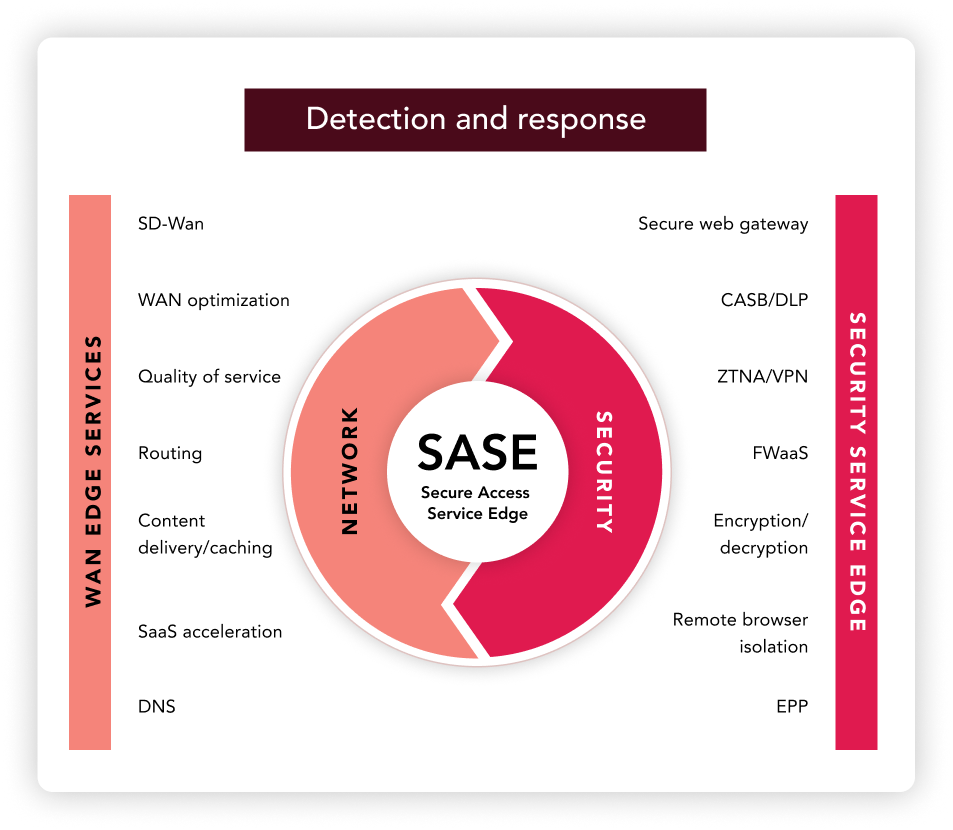
SASE stands for Secure Access Service Edge. Gartner introduced the term in 2019 to describe an architecture that combines networking and security functions into a cloud-native service delivered from distributed cloud locations close to the user, at the edge, no longer centralised in the data centre.
A mature SASE platform comprises five core components that together form an integrated whole. SD-WAN handles intelligent connectivity between sites and replaces static MPLS links with dynamic routing across any available connection. FWaaS delivers next-generation firewall protection from the cloud, without hardware at every location. SWG protects users when they access the internet by filtering malicious traffic based on real-time threat intelligence. CASB monitors access to cloud applications and enforces policy on data flowing through SaaS environments. ZTNA replaces VPN with identity-driven access on a least-privilege basis: no one gets more access than strictly necessary.
What sets SASE apart from a random bundle of separate products is the single-pass principle: all security engines inspect traffic simultaneously, without latency, from a single policy engine. One console for management, one audit trail for compliance, one vendor for the full stack. For IT teams tired of complexity, that is a fundamentally different starting point.
For more depth on the architecture and the five components, see our article on what SASE is and how the architecture works. The specific difference with SSE is explained in our SASE versus SSE comparison.
"The organisations that migrate to SASE fastest are not always the largest. They are the ones that understand fastest that they are solving a networking problem and a security problem at the same time. That insight, combined with the right partner who delivers both underlay and overlay, is what separates a migration that drags on for months from one that brings the first sites live within six weeks."
Momentum EMEA, EMEA's leading Cato Networks implementation partner
Cato Networks as a platform and why it is different
There are dozens of SASE vendors. But there is one fundamental distinction you need to understand before you make a shortlist: the difference between a platform and a portfolio.
A portfolio is a collection of products that a vendor has built or acquired over the years and brought together under one brand name. They work, but not seamlessly. There are integration points to be managed, separate update cycles and dependencies that create operational complexity.
Cato Networks is different. The platform was built from the ground up as a single cloud-native architecture, powered by a GPU-based global private backbone with more than 85 Points of Presence worldwide. All security engines run in the same single-pass engine. All policies are managed from one console. All telemetry flows into one data platform for AI-driven detection.
In July 2025 Gartner recognised Cato Networks as a Leader in the Magic Quadrant for SASE Platforms for the second year in a row. In March 2026 Cato launched a modular adoption model that lets organisations start with the module that is most urgent, AI Security, SD-WAN, SSE or Universal ZTNA, and extend in phases without re-architecting and without additional licence costs for the transition.
Read more about the platform, the four modules and the technical differentiation in our article on the Cato Networks platform.
From MPLS to cloud-native: the migration route that works
Most international organisations are still locked into MPLS contracts. That is understandable: MPLS delivers predictable performance and has been the backbone of many networks for years. But the costs are high, scalability is limited, and cloud optimisation is virtually zero.
Migrating from MPLS to SD-WAN and SASE is not a big bang. Momentum EMEA uses a phased approach in which the existing infrastructure continues to run in parallel while sites are moved over to Cato one by one. Zero-touch deployment via the Cato Socket means that a site in Germany, Singapore or Sao Paulo can go live without technical staff on the ground. The 4G/5G backup fallback is built in as standard.
Carrier-neutral working is a critical Momentum EMEA advantage here. We are not tied to a single ISP, which means we select the best connectivity option per site and combine it all in one contract and one SLA with the Cato SASE overlay. Read more about the migration approach in our guide on replacing MPLS with SD-WAN and SASE.
NIS2, shadow AI and Zero Trust: the urgent themes of 2026
Three developments dominate the agenda of every CIO and CISO this year. They cannot be viewed in isolation, and all three call for the same answer: a converged platform that delivers visibility, control and demonstrability.
NIS2 and the Cyber Resilience Act. The Dutch transposition of NIS2, the Cyberbeveiligingswet, is approaching enforcement in Q2 2026. For organisations in logistics, manufacturing, business services and other designated sectors this means a duty of care, a reporting obligation and a registration obligation. Directors become personally liable. SASE supports NIS2 compliance directly: ZTNA delivers demonstrable access control, DLP prevents data loss, unified logging produces audit trails and 24/7 monitoring meets the detection and response requirements. Read how this works in our article on NIS2 compliance with one platform.
Shadow AI. More than ninety percent of employees in business environments now use AI tools (ChatGPT, Copilot, Gemini) even when IT has not approved them. Company data disappears into public models. GDPR violations are lurking. Banning does not work. What works is gaining visibility into which AI tools are being used, enforcing policy through traffic inspection and offering employees safe alternatives. Cato AI Security is purpose-built for this and detects and manages shadow AI in real time from the same platform. Read more about detecting and controlling shadow AI.
Zero Trust. Zero Trust is not a product but a principle: never trust implicitly, always verify, grant least-privilege access to every user on every device from every location. Cato realises Zero Trust technically through ZTNA, microsegmentation, device posture checks and continuous monitoring. It replaces VPN architectures built on the outdated assumption that anyone on the network is also trusted.
Momentum EMEA as implementation partner: underlay and overlay, one source
Many SASE partners deliver the technology. Momentum EMEA delivers more than that.
As EMEA's leading specialised Cato implementation partner we combine the underlay, carrier-neutral internet connectivity for all your sites worldwide, with the overlay of the Cato SASE platform, from one contract, one SLA and one point of contact. That is a fundamentally different proposition than a reseller who only sells a licence and passes the implementation to a third party.
Our implementation method follows four phases: observe (map the current architecture and security posture), design (architecture design and module selection), deliver (phased roll-out with zero-touch deployment) and care (proactive monitoring, quarterly reviews and continuous optimisation). After go-live our 24/7 NOC team monitors your network proactively, not reactively on tickets, with engineers who flag anomalies before they become incidents.
Service tiers run from Silver (monitoring) through Gold (business-hours support) to Platinum (24/7 proactive management). Want to know what this means for your organisation in euros and months? Calculate the ROI through our article on SASE cost and ROI or read how managed SASE works in practice.
Ready to get started?
Book a free network assessment with one of our Cato specialists. In 30 minutes you will map where your organisation stands, where the fastest wins are and what a phased migration to SASE looks like for your specific situation.
Or call directly: +31 20 226 1500. Momentum EMEA, Ede
SASE and Cato Networks frequently asked questions
What is SASE and which organisations is it suitable for?
SASE (Secure Access Service Edge) is a cloud-native architecture that converges networking and security functions into one platform. It suits any organisation with multiple sites, hybrid workers or a cloud-first strategy that wants to control connectivity and security without a sprawl of separate tools.
What is the difference between SASE and SSE?
SSE (Security Service Edge) is the security layer of SASE: SWG, CASB, ZTNA and FWaaS. SASE adds SD-WAN for network transformation. Whoever already has a working SD-WAN can start with SSE. Whoever wants to modernise the network as well chooses full SASE. Cato offers both from the same platform.
How does SASE help with NIS2 compliance?
SASE addresses multiple technical NIS2 obligations at once: ZTNA delivers demonstrable least-privilege access control, DLP prevents data loss, unified logging produces audit trails and 24/7 monitoring meets detection and response requirements.
How long does a SASE implementation with Momentum EMEA take?
First sites are typically live within two to four weeks via zero-touch deployment. Migrating a full international network takes six to twelve weeks depending on the number of sites and the complexity of the existing infrastructure. The implementation runs in parallel with the existing network so continuity is guaranteed.
What does SASE cost via Momentum EMEA?
Cato uses a pricing model based on users and bandwidth per site, modular per module (AI Security, SD-WAN, SSE, Universal ZTNA). Momentum EMEA combines this with carrier-neutral internet connectivity in a single invoice. Forrester calculated a 235% ROI over three years for Cato implementations.
What does Momentum EMEA do differently from other Cato partners?
Momentum EMEA is EMEA's leading specialised Cato implementation partner and the only partner that delivers underlay (carrier-neutral connectivity for all your sites) and overlay (Cato SASE platform) from one contract, one SLA and one team. This eliminates the coordination friction between network and security vendor entirely.